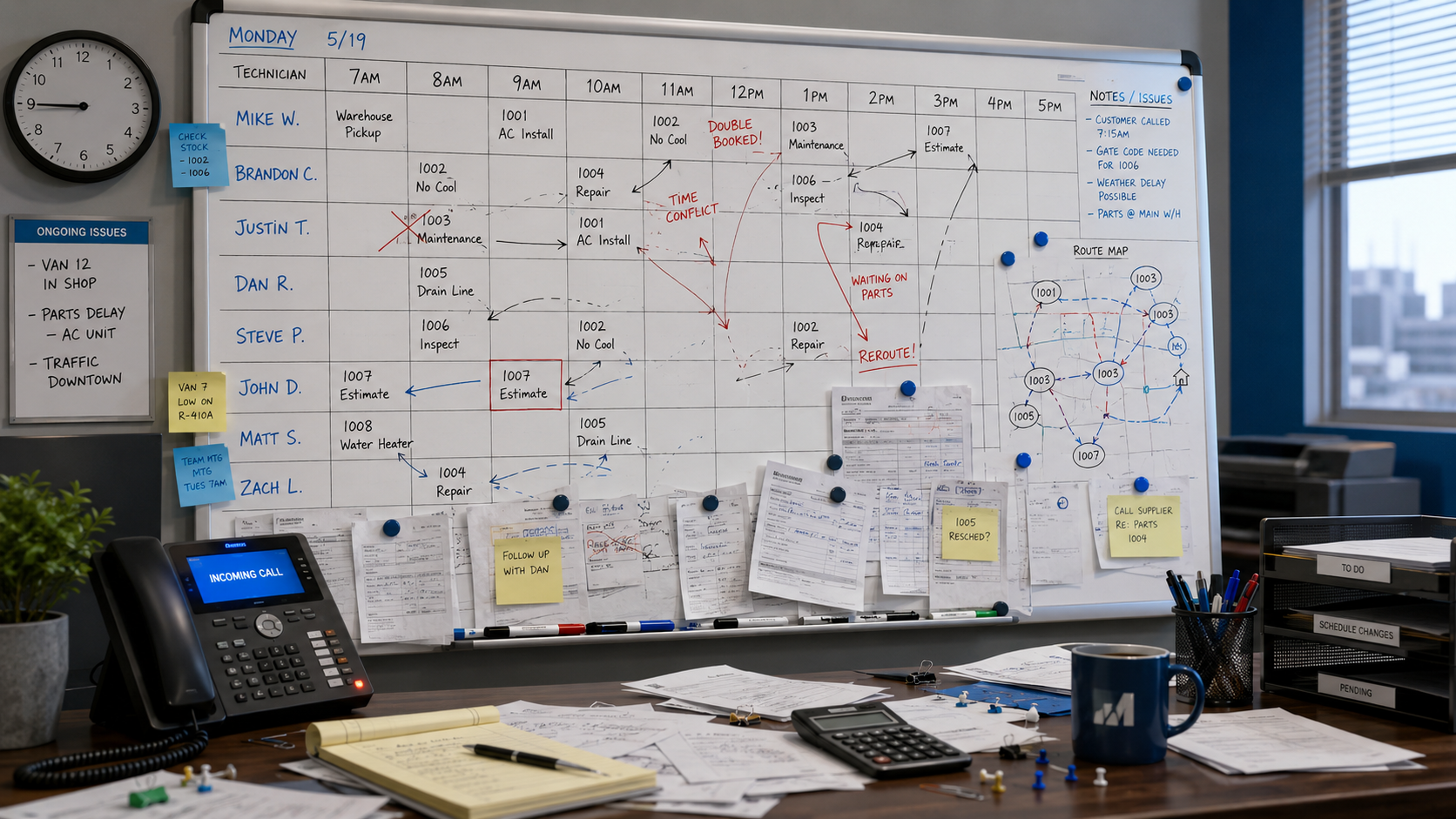
A whiteboard looks free. Here's how to actually calculate what manual dispatching is costing you in payroll, fuel, and wasted trips, and what changes when you automate it.
A whiteboard costs about thirty dollars. A spreadsheet is free. It's easy to look at that and assume manual dispatching doesn't cost you anything.
It does. It just doesn't show up as a line item, it shows up in payroll hours, fuel, callbacks, and customers who quietly stop booking with you. Here's how to actually see it.
Put a number on it
This is worth doing even if you never change a thing afterward, because most business owners underestimate it badly.
Track the hours. For one week, have your dispatcher log time spent building the schedule, texting technicians, and answering "where's my tech" calls.
Get the real hourly cost. Wages plus taxes and benefits, not just the paycheck number.
Do the math. Weekly hours on manual tasks, times hourly cost, times 52.
A dispatcher spending even two hours a day on manual scheduling and check in calls, at a fully loaded $25 an hour, is around $13,000 a year. Two dispatchers, and you're at $26,000 spent keeping a whiteboard fed instead of growing the business.
Where the rest of the cost hides
Beyond the dispatcher's own hours, manual scheduling tends to leak money in a few predictable places:
Mistakes that cost a second trip. Double booked technicians, a job assigned to someone without the right skill for it, an address copied wrong. Each one means a wasted trip and an annoyed customer.
Wasted drive time. A route planned by hand rarely matches a route planned well. Technicians backtrack, or two trucks cross paths going opposite directions, and every extra mile is time not spent on billable work.
A growth ceiling. Doubling your trucks doesn't double the dispatcher's workload, it multiplies it. At some point the only way to grow is hiring another dispatcher, which eats into the margin the growth was supposed to create.
Disputes that take real time to untangle. Without a clean record of who went where and when, a customer dispute becomes a slow investigation instead of a quick answer.
What actually changes with automation
The fix isn't complicated in concept. It's mostly about moving the parts of dispatching that are just math, distance, timing, who's free, out of a person's head and into software that can do it instantly.
The typical payoff shows up in a few places:
Hours back. Building a route that used to take a couple hours by hand can take minutes once the software is doing the calculation.
Fewer wasted miles. Tighter, better sequenced routes mean less driving between jobs, which shows up directly in fuel and vehicle wear.
More done per technician. When less of the day is spent driving, more of it is available for actual jobs, without adding headcount.
Faster answers on disputes. A digital record with photos, signatures, and timestamps turns a "did you even show up" call into a two minute lookup.
Making the switch without the chaos
Moving off a system your team has used for years is the part that actually feels risky, even once the math is obvious. A few things make it go smoother:
Audit first. Write down the actual pain points, not just "we should upgrade." "Routing takes three hours" is something you can fix and later measure.
Get the team's buy-in early. Frame it as removing the tedious part of the job, not replacing the dispatcher's judgment.
Clean your data before you import it. Bad addresses and outdated customer info will undercut even the best routing software.
Run it in parallel for a bit. A short overlap period where the old system is still the backup builds confidence without betting everything on day one.
How this works in Momentum FSM
Momentum FSM builds your daily routes directly from scheduled visits, with stop order and progress tracking your office can see without a phone call. Employees carry their own service groups and field teams, so matching the right technician to a job is part of scheduling itself, not a separate step someone has to remember. And because every visit carries its own status history, photos, and signatures, a dispute doesn't turn into an investigation, it turns into pulling up the record.
None of that makes dispatching free. It just means the cost stops being hidden in hours nobody's tracking.